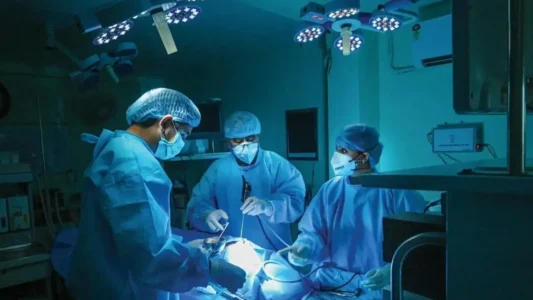
Doctors in Kolkata have given a new lease of life to a man suffering from severe sleep apnoea with treatment through a timely surgery, helping restore his breathing again.
Severe snoring, repeated breath-holding, choking spells during sleep, and significant sleep disturbance and excessive daytime sleepiness led to the diagnosis of obstructive sleep apnoea, commonly known as OSA, a condition where the airway repeatedly gets blocked during sleep, in the 26-year-old marine engineer.
A previous polysomnography (detailed sleep study) had recorded an Apnoea-Hypopnoea Index (AHI) (the number of times breathing stops or becomes very shallow per hour) of over 40, along with a significant drop in blood oxygen levels. The man was referred to Dr Dipankar Datta, who is a senior consultant- ENT and Sleep Apnea Surgeon at Manipal Hospital in Broadway. As he was non-obese and did not wish to depend on CPAP (a machine that keeps the airway open with continuous air pressure during sleep) for long-term treatment, a targeted multi-level surgery was chosen as the best option.
Treating Obstructive Sleep Apnoea in a non-obese man
Before surgery, an advanced test called Drug-Induced Sleep Endoscopy (DISE), a test that shows where the airway gets blocked during sleep, was performed. It showed blockages at multiple levels, including nasopharynx, which is the junction of nose and throat, the palate, which is the soft tissue at the back of the mouth, and throat. The man also had a deviated nasal septum, a bent partition inside the nose, while the tongue caused only minor blockage. Based on these findings, the team performed a targeted, minimally invasive surgery involving septoplasty (straightening the nasal septum) and Barbed Palatopharyngoplasty(reshaping and supporting the palate and throat to improve airflow using special barbed sutures).
The procedure used endoscopic and microscopic assistance with a coblation technique (Bloodless and painless technique using Plasma energy). By treating the specific areas causing the blockage, the surgery improved the patient’s airway without extensive removal of the palate or uvula (the small hanging tissue at the back of the mouth). Following the surgery, the patient showed good recovery with significant relief from his symptoms and within two days.
Speaking about the case, Dr Datta stated, “This was an unusual case as the patient was only 26 years old and non-obese. Since his profession as a marine engineer requires good-quality sleep and alertness, it was important to find a definitive solution. Sleep endoscopy helped us identify exactly where his airway was collapsing during sleep, particularly at the level of the palate and oropharynx. Based on these findings, we performed a targeted multi-level surgery involving septoplasty and Barbed Palatopharyngoplasty. The patient has recovered well, and we are hopeful that he will be able to resume his professional duties after completing his recovery.”
Sharing his experience, the man said, “The constant snoring, disturbed sleep and choking episodes had started affecting my daily life and were also becoming a concern for my work. As a marine engineer, getting proper sleep and being alert are extremely important for me. I was initially worried about undergoing surgery, but Dr Datta and his team explained the problem and the treatment clearly. I am feeling much better after the procedure, my sleep is much better now and am hopeful that I will be able to return to my duties soon.”
The man has recovered well following the surgery and has been discharged. He will gradually return to a soft and normal diet over the next few days and has reported that his sleep has significantly improved following the procedure. As part of his recovery, he plans to resume his professional duties as a marine engineer on his next shipment, subject to medical clearance. He has also been advised to remain in follow-up with the medical team when he returns to Kolkata.
Kolkata docs give new lease of life to man suffering from severe sleep apnoea