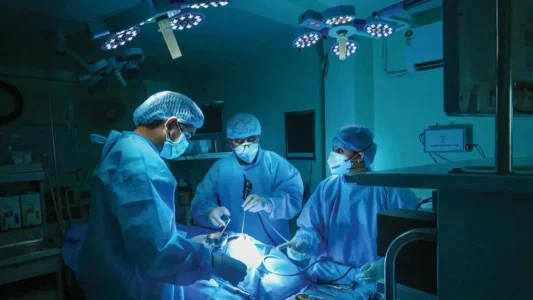
Doctors at a hospital in Thane have given an elderly woman a new lease of life after treating her with a timely procedure amid complex history of heart disease and bleeding.
At 71, the woman with severe aortic stenosis faced an additional challenge that made treating her heart condition particularly complex. Along with the narrowing of her aortic valve, she had a history of gastrointestinal bleeding due to esophagitis and had previously required multiple blood transfusions.
Complicated health history
Her medical history meant that the treatment strategy had to balance the need to correct the severely narrowed heart valve while carefully minimising the risk of further bleeding.
After detailed evaluation and multidisciplinary planning, the cardiac team at KIMS Hospitals, Thane, decided to perform a Transcatheter Aortic Valve Implantation (TAVI), a minimally invasive procedure in which a replacement valve is delivered through a catheter and positioned inside the diseased aortic valve.
The procedure was performed by Dr. B. C. Kalmath, who is the director & head, Department of Cardiac Sciences, KIMS Hospitals in Thane.
In patients with severe aortic stenosis, the aortic valve becomes narrowed and restricts the flow of blood from the heart to the rest of the body. As the condition progresses, patients may develop breathlessness, chest discomfort, fatigue, dizziness or reduced exercise tolerance. In elderly patients or those with additional medical conditions, choosing the safest approach to valve replacement becomes particularly important.
For this patient, her previous episodes of gastrointestinal bleeding added another layer of complexity to the procedure. Careful assessment and peri-procedural planning were therefore essential to minimise the possibility of bleeding complications while ensuring successful treatment of the valve disease.
Treatment of the elderly woman
Speaking about the case, Dr Kalmath said, “Treating severe aortic stenosis in a patient with a significant history of gastrointestinal bleeding requires careful planning. In such cases, the objective is not only to treat the diseased valve but also to anticipate and minimise potential complications. TAVI allowed us to treat the valve through a minimally invasive approach, while the patient was closely monitored for bleeding and other complications. She had a smooth recovery, with no haematoma or bleeding complications following the procedure, and was able to return home within 48 hours.”
Unlike conventional open-heart valve replacement, TAVI does not generally require opening the chest or placing the patient on a heart-lung bypass machine. The replacement valve is introduced through a catheter, most commonly through an artery in the groin, and guided to the heart, where it is deployed within the diseased native valve.
The minimally invasive nature of TAVI can allow appropriate patients to recover faster and spend less time in hospital, although the decision between TAVI and surgical valve replacement depends on several factors including age, overall health, anatomy, surgical risk and associated medical conditions.
In this case, the patient was shifted to the ICU after the procedure and remained stable, with no haematoma or bleeding complications reported during the immediate postoperative period. She continued to recover well and was *discharged just 48 hours after the procedure without any complaints*.
The case highlights the importance of individualised treatment planning in elderly patients with severe aortic stenosis, particularly when other medical conditions can increase the complexity of intervention. A history of significant bleeding does not automatically rule out valve replacement, but it requires careful assessment of the patient’s bleeding and thrombotic risks and close monitoring throughout the treatment pathway.
For patients with severe aortic stenosis, symptoms such as unexplained breathlessness, persistent fatigue, dizziness, chest discomfort or a decline in the ability to perform routine activities should not be dismissed as simply part of ageing. Early cardiac evaluation can help identify valve disease and determine the appropriate treatment before the condition progresses further.
For this 71-year-old woman, meticulous planning and a minimally invasive approach helped overcome a complex clinical challenge, allowing her to leave the hospital within two days and return home after a successful valve replacement.
Thane docs give new lease of life to elderly woman suffering from heart issue